
Introduction
You’re a high-achiever. Externally, you meet every deadline, lead every project, and exceed every expectation. But internally, it’s a different story. You’re fighting a private battle against chronic stress, mental fog, and a persistent hum of emotional friction that productivity hacks and positive thinking can’t seem to silence. You feel like you’re constantly running damage control on your own internal state. But what if the problem isn’t a lack of effort, willpower, or the right coping strategy? What if the issue is a fundamental glitch in your internal operating sequence?
The Vicious Cycle of ‘Damage Control’
Many conventional stress management techniques—meditation apps, breathing exercises, even therapy—often feel like temporary patches. They are designed to manage the symptoms after you’re already feeling overwhelmed, anxious, or irritable. This is a ‘damage control’ approach. While it can provide momentary relief, it rarely addresses the underlying mechanism that triggers the stress response in the first place. This is why you feel stuck in a loop: you experience a trigger, become emotionally reactive, apply a coping tool to calm down, and then repeat the cycle the next day. It’s exhausting because you’re constantly fighting a fire instead of preventing it from starting.

The Real Culprit: Your Default Mode Network (DMN) on Overdrive
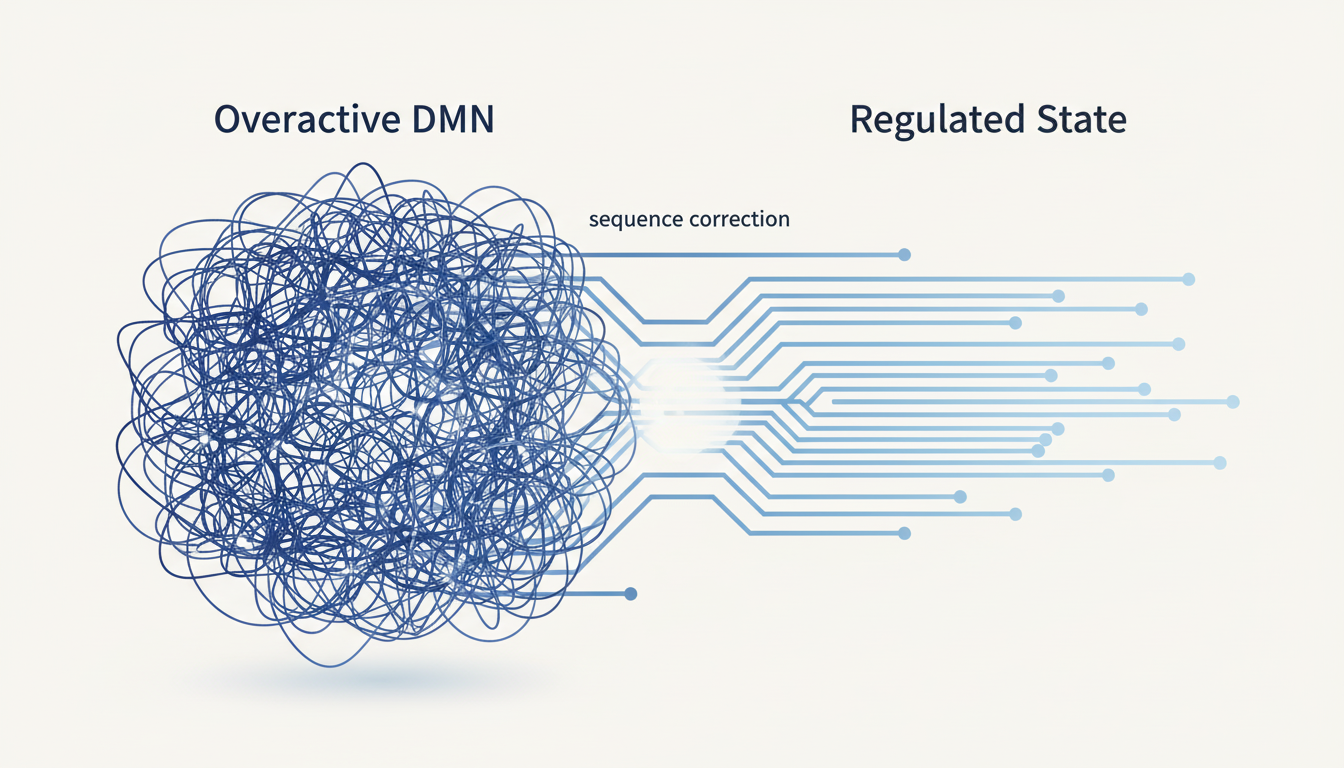
Neuroscience offers a deeper insight into this cycle. The root cause often lies within the brain’s Default Mode Network (DMN). Think of the DMN as your brain’s autopilot—it’s active when you’re not focused on a specific task, allowing your mind to wander, self-reflect, and think about the past or future. For high-performing individuals under chronic stress, this network can go into overdrive. It learns to default to habitual negative thought patterns, anxieties, and threat assessments. This activation happens before your conscious mind can even process the situation, triggering a cascade of emotional friction, mental fog, and physical tension. You aren’t choosing to feel stressed; your system’s sequence is running a pre-programmed, protective script.
The CELF Solution – Upstream Intervention
If the problem is a faulty sequence, the solution isn’t more damage control—it’s sequence correction. This is the core principle behind the CELF system. Instead of managing the emotional fallout, our neuroscience-consistent, timing-based training provides a causal intervention. It works upstream, intervening in the critical window before the overactive DMN or habitual emotional conditioning takes over. By using practical, physiological techniques like the ‘Screen Gate™’ system, you learn to restore your nervous system’s authority. This isn’t about suppressing emotions or forcing a positive mindset; it’s about fundamentally re-establishing your ability to self-govern your internal state at the source.
From Reactivity to Command – The Tangible Results
For a professional like a Marketing Director who constantly juggles high-stakes projects and team dynamics, this shift is game-changing. Moving from a reactive to a commanding internal state produces immediate, measurable outcomes. The constant internal activation fades, replaced by predictable internal control. The mental fog that clouds strategic thinking lifts, leading to sustained mental clarity, even under intense pressure. This means better decisions, more effective leadership, and the end of the burnout cycle. By treating your internal state as critical performance infrastructure, you move beyond merely surviving your workday to truly thriving in it, with the resilience and focus to meet any challenge.
Conclusion
Ultimately, escaping the burnout cycle requires a fundamental paradigm shift—from passively coping with stress to actively gaining authorship over your internal world. The endless loop of reactivity is not a personal failing; it’s a systemic one that can be corrected. By intervening at the causal level with a scientific, timing-based approach, you can move beyond temporary fixes and achieve lasting internal stability and command.
Ready to stop managing the symptoms and start addressing the cause? Discover how the CELF system provides the tools to correct your internal sequence, turn off the autopilot of stress, and build a foundation of genuine resilience. Take the first step toward reclaiming your nervous system authority and unlocking your true potential.
Leave a Reply